The Large Electron Positron Collider (LEP)

**This page was archived on 1 December 2008 as the content is out of date**

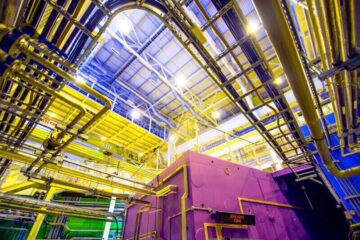
The 27 kilometre circumference LEP machine at CERN (the European Laboratory for particle physics) ran from 1986 until 2000, colliding electrons with their antimatter partners, positrons.

When an electron and a positron collide, they disappear in a burst of energy which, almost immediately, changes back into particles. LEP was designed so that the collisions took place inside four detectors where the particles produced could be studied in detail. The Science and Technology Facilities Council was involved in funding the construction and operation of three of these detectors: ALEPH (Apparatus for LEP Physics at CERN), OPAL (the Omni-purpose Apparatus at LEP) and DELPHI (Detector with Lepton, Photon and Hadronic Identification at LEP.

The nature of the particles generated in these collisions depends upon the speed, or energy, of the colliding electrons and positrons. Between 1989 and 1995 their energy was tuned exactly to the value needed to create Z0 particles, the neutral carrier of the weak nuclear force. Between 1996 and 2000, the collision energy was increased to produce two heavier particles, the W+ and W-, the charged carriers of the weak neutral force. The detection and study of millions of these three particles has allowed LEP to make extremely precise tests of the standard model of particles and their interactions.

Although the LEP project has now finished, with the collider being removed to make way for the Large Hadron Collider which is to be built in the same tunnel, the analysis of the enormous quantity of data generated by the LEP experiments continues.

Page last updated: 01 December 2008 by Charlotte Jamieson